
The 80/80/80 Strategy Problem
Greater Alignment of Strategy Direction, Integration, and Execution
Introduction
One way to look at the work of strategy in any organization involves taking care of today while, at the same time, getting ready for tomorrow. Maybe that’s too simple. Or maybe, it’s quite sound and practical. From our executive and board interviews, this frame of strategy is gaining appeal.Let’s consider the landscape of business today. We have a marketplace that’s disruptive and complex. Depending on the sector, the marketplace can be noisy with technical, social, political, and economic forces. We also have organizational challenges with workforce and workplace elements that are redefining the practical work to be done and the so-called organization of the future.

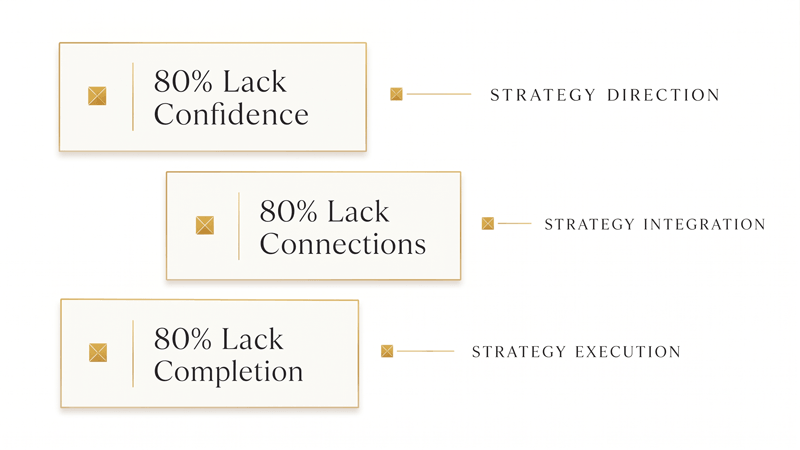
- Strategy Direction – The Direction and Choices made at the very top of their strategic thinking and intentions pose problems with:
– Chasing Scale, Market Leverage, Sweet Spots - Strategy Integration – The Priorities and Resources that combine and connect with operating plans, systems, pose problems with:
– Priority Maps, Resource Bins, Match Games - Strategy Execution – the Actions and Impacts that are deployed and realized at the front lines of organizations pose problems with:
– Effort Tracks, Progress Metrics, Agile Tactics
Today, our observations are essentially the same. Roughly 80% of execs and boards have serious concerns about the elements, connections, and leverage of their Strategic Agenda, – the combined effects of their Strategy Direction, Strategy Integration, and Strategy Execution. We’ve called this the 80/80/80 Problem. And the evidence suggests it’s more than misalignment.

Leadership Steps Back, Looks Forward
We go along with the idea that Leadership is the Influence of Attention, and in this context, we mean attention to decision making, risk management, and problem solving with the company’s strategic agenda. We need better attention to challenges in Strategy Direction, smarter attention to the systems and norms of Strategy Integration, and faster attention to the actions and impacts of Strategy Execution.This means thoughtful attention to critical perspectives. And more urgent attention to options for growth, performance, and change. And more constructive attention to strategic adaptation. Where should we be more thoughtfully engaged?
- In the Boardroom
– With board insights and regular debate - Across the Executive Team
– With data-informed assumptions, choices - Across the Management Ranks
– With issues and options across all functions - At the Front Lines, the First Level
– With demand/supply, focus on adaptation
The work of strategy today has to be more multi-faceted and pragmatic. And as we stated in Prepared and Resolved twenty years ago, there are opportunities for better strategy engagement in 80/80/80 terms. In most organizations – corporate as well as nonprofits – executives, boards, and the whole of workforce can do better. The starting point has three principles:
Begin with a Dual-Dynamic Mindset.
Focus on Taking Care of Today While Getting Ready for Tomorrow.
Next, Match Strategy, Resources, and Culture.
Be Thorough, Be Bolder, Be Serious About Systems and Discipline.
And, Practice Leadership as the Influence of Attention.
Get the Big Ideas Right, Engage People, Connect, Adapt and Evolve.

